AI is not replacing sales teams. And it is not replacing customer success teams either.
What it is replacing, very quickly, is slow follow-up, weak thinking, and the kind of average execution many businesses got used to tolerating for far too long.
For years, a lot of teams have mistaken motion for value. If someone was busy updating the CRM, sending reminders, chasing people for replies, or manually pushing the next step forward, it felt like important work was happening. And to be fair, those things do matter. Deals can stall without follow-up. Customers can drift without attention. Opportunities can disappear when nobody owns the next move.
But here’s the shift: once AI can handle more of that repetitive work faster, more consistently, and with less friction, the standard changes.
That means the value of the human role moves up.
Now the real question is not whether someone stayed busy all day. It is whether they understood the real business problem, saw risk early, moved the right opportunity forward, and built trust where the stakes were actually high.
That is where this is all heading.
And that is why this moment matters so much for sales and customer success teams. Because the issue is no longer just whether AI is being used. The issue is what kind of work is still worth humans doing in the first place.
Table of Contents
- The real problem: teams have been confusing activity with value
- What AI is actually good at
- What human value now looks like in sales and customer success
- Why this shift is uncomfortable
- The real leverage point: fix revenue leaks, not just workload
- What winning teams will do differently
- Why a system matters more than tools
- Final thoughts
The real problem: teams have been confusing activity with value
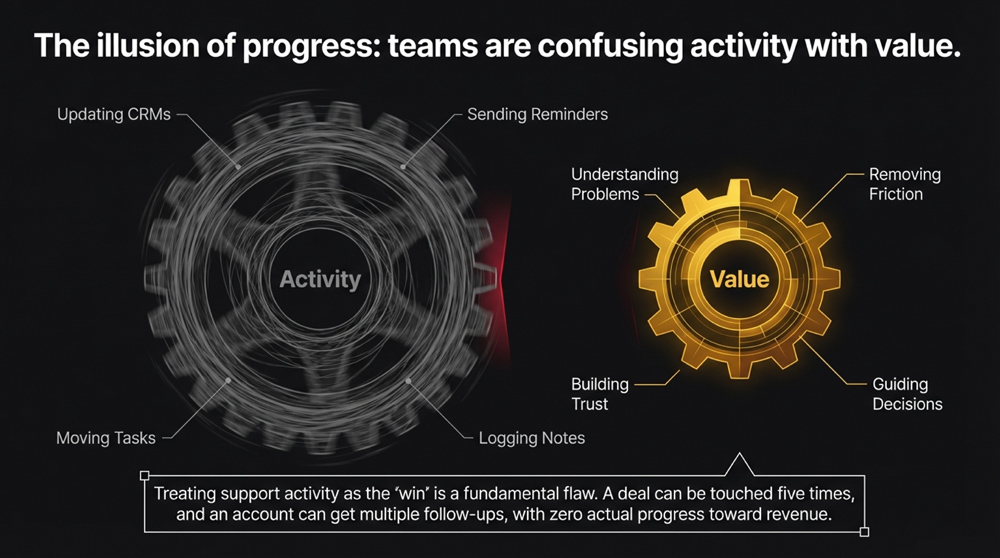
For a long time, a lot of teams have confused activity with value.
Someone updates the CRM. Another follow-up email goes out. A reminder gets sent. Notes get logged. Tasks get moved. A rep checks in again. A customer success manager schedules another touchpoint.
On the surface, all of that can look like productive work. People are moving. Things are happening. The team looks busy.
But busy is not the same as valuable.
A deal can be touched five times and still go nowhere. An account can get multiple follow-ups and still have no real progress. A team can spend hours updating records, answering repeat questions, and pushing tasks around without doing much to increase revenue, reduce risk, or move a customer toward a better outcome.
That is the real problem.
A lot of what gets treated as important work is actually support activity around the real value, not the value itself. The CRM update is not the win. The reminder is not the win. The templated response is not the win.
Those things can help, sure. But the real value comes from understanding the business problem, removing friction, guiding the next decision, strengthening trust, and helping move revenue forward.
Now that AI can handle a growing share of repetitive admin and routine follow-up faster and more consistently than most people, that gap is becoming harder to hide.
Simply staying active is no longer enough. Simply touching the account is no longer enough. Simply completing tasks is no longer enough.
What matters is whether the work is creating progress.
And once that becomes clear, the next issue is hard to avoid: what exactly should AI handle, and what should humans still own?
What AI is actually good at
That is where the picture starts to sharpen.
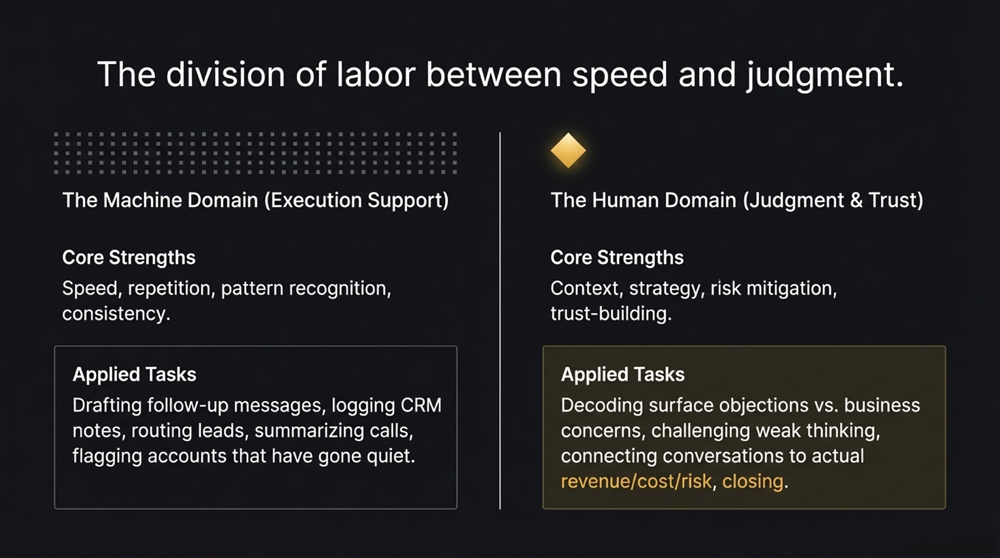
AI is not best at replacing judgment. It is best at handling the kind of work that depends on speed, repetition, pattern recognition, and consistency.
It is good at drafting follow-up messages. It is good at logging and organizing CRM notes. It is good at summarizing calls, pulling out action items, and prompting the next step. It is good at answering common questions, flagging stalled deals, identifying accounts that have gone quiet, and helping teams stay on top of routine communication that would otherwise slip through the cracks.
In other words, AI is very good at supporting execution.
And in a lot of businesses, that matters more than people want to admit. Because many revenue problems do not start with some deep strategic failure. They start with delayed responses, missed handoffs, forgotten follow-ups, inconsistent outreach, and small breakdowns that pile up until deals slow down or customers drift.
AI can help reduce that friction.
But that does not mean AI is the fix by itself. It only makes a real difference when it is improving a process that should exist in the first place. If the workflow is broken, the ownership is unclear, or the next step was never defined well to begin with, AI does not solve that. It just helps the business move through the same weak system faster.
Which is exactly why the human role now becomes more important in a different way. If AI is handling more of the repetitive execution, then the value of the person has to move higher.
What human value now looks like in sales and customer success
That shift changes what strong sales and customer success work actually looks like.
The value is no longer in being the person who manually keeps everything moving through effort alone. The value now sits higher up, in the parts of the job that require judgment, context, and trust.
Can you understand what is really slowing the deal down?
Can you tell the difference between a surface objection and a deeper business concern?
Can you challenge weak thinking without creating friction that kills trust?
Can you connect the conversation to revenue, cost, risk, retention, or growth in a way that actually matters to the buyer?
That is where human value becomes much harder to replace.
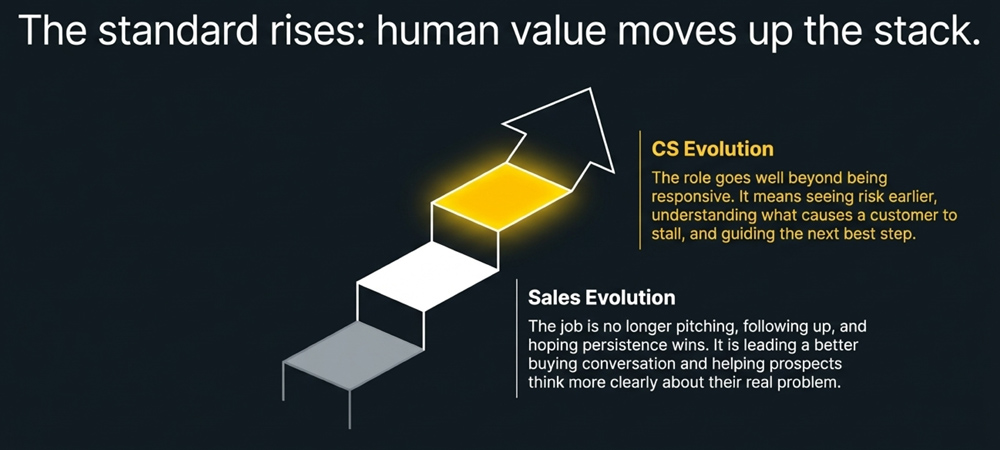
In sales, that means the job is no longer just pitching, following up, and hoping persistence wins. It means leading a better buying conversation. It means helping the prospect think more clearly, see the real problem faster, and understand why action now makes business sense.
And in customer success, it means the role goes well beyond being responsive and helpful. It means seeing risk earlier, understanding what could cause the customer to stall or leave, guiding the next best step, and helping the customer reach an outcome they can actually feel.
So the winning teams will not just be more efficient. They will think more like operators and advisors.
They will ask better questions. They will spot weak assumptions sooner. They will make the next move clearer. And they will use AI to support that work, not to substitute for it.
Which is also why this shift is going to feel uncomfortable for a lot of teams. The more AI takes over repetitive execution, the more exposed average performance becomes.
Why this shift is uncomfortable
That is where the discomfort starts. For a long time, teams could hide behind activity.
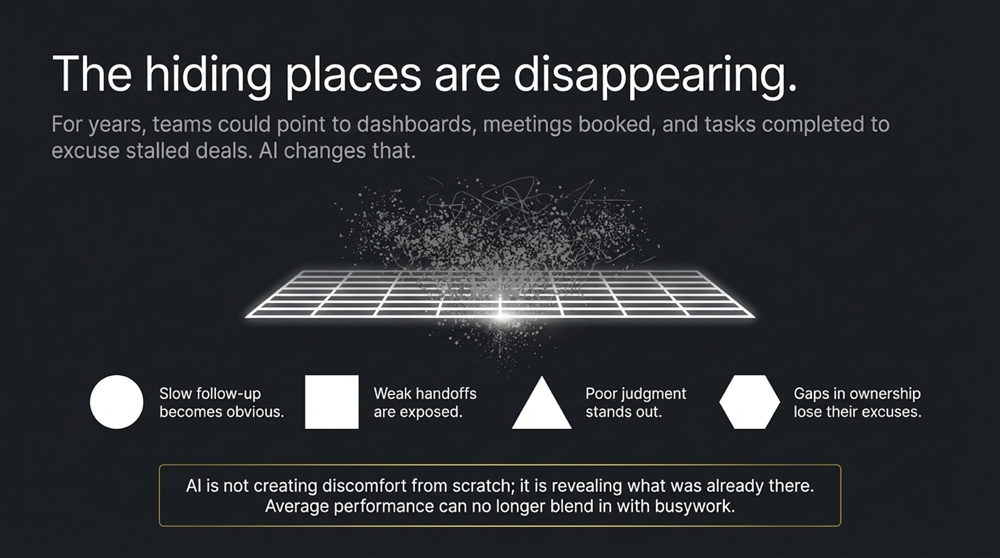
They could point to follow-ups sent, tasks completed, notes logged, meetings booked, and dashboards updated. And because all of that looked like movement, it was easy to assume the work was strong enough. Even when deals kept stalling. Even when prospects went cold. Even when customers quietly disengaged after the sale.
AI changes that.
Once repetitive execution becomes easier, faster, and more consistent, the hiding places start to disappear. Slow follow-up becomes more obvious. Weak handoffs become easier to spot. Poor judgment stands out faster. Gaps in ownership become harder to excuse. Average performance has less room to blend in with busywork.
That is what makes this shift uncomfortable.
Not because sales or customer success matter less. They still matter a lot. In some ways, they matter more. But the standard is rising. When AI can handle a growing share of routine execution, people get judged less on whether they stayed busy and more on whether they moved the right outcome forward.
And that exposes a hard truth.
Some teams were never underperforming because they lacked effort. They were underperforming because too much of their day was tied up in low-value work, weak systems, and habits that looked productive but did not create enough progress.
So no, AI is not creating all this discomfort from scratch. It is revealing what was already there.
And once that becomes visible, the next question is not whether to use AI at all. It is where to apply it so it actually improves revenue execution instead of just speeding up the wrong work.
The real leverage point: fix revenue leaks, not just workload
That is the real leverage point.
The goal is not to use AI just to help the team get through more tasks. The goal is to use it where revenue is already leaking.
That is a very different mindset.
A lot of businesses start with workload. They ask how AI can save time, reduce admin, or help the team do more with less effort. And yes, that matters. But time savings alone do not mean much if the same problems are still sitting underneath the workflow.
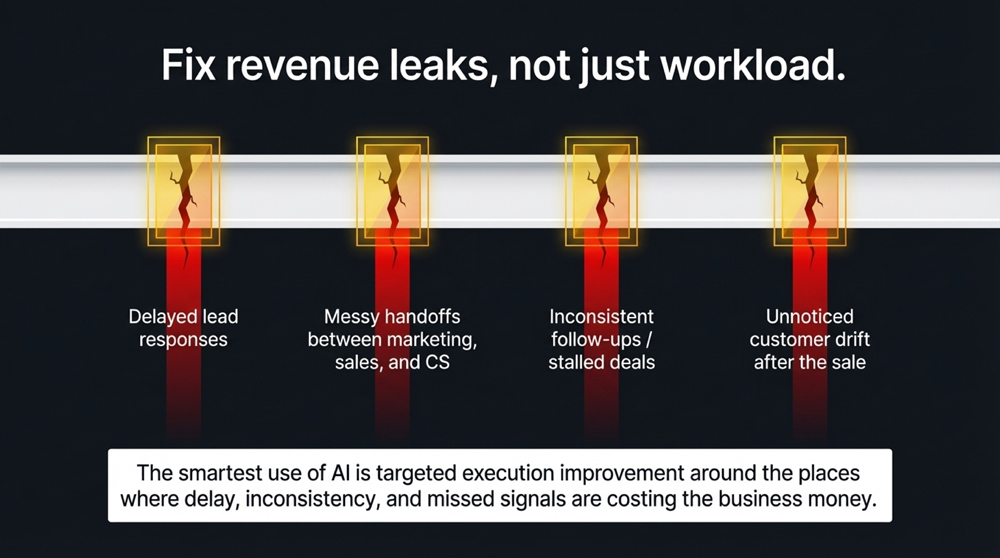
If leads still wait too long for a response, revenue leaks.
If handoffs between marketing, sales, and customer success are messy, revenue leaks.
If follow-up is inconsistent, if deals stall without clear next steps, if customers go quiet after the sale, if renewal conversations start too late, revenue leaks.
That is where the real opportunity sits.
AI should be applied to the points where delay, inconsistency, and missed signals are costing the business money. It should help route leads faster, trigger follow-up sooner, surface risk earlier, prompt the right next step, and keep important opportunities from going cold simply because no one moved in time.
In other words, the smartest use of AI is not random automation. It is targeted execution improvement around the places where money is slipping out of the system.
Because if all AI does is help the team complete low-value work faster, then the business did not really improve revenue execution. It just increased the speed of activity.
And once you see AI that way, the next thing becomes much clearer: the teams that win will not be the ones with the most tools. They will be the ones that use AI inside a more disciplined way of operating.
What winning teams will do differently
That is where the separation will happen.
The teams that win will not just use AI to work faster. They will use it to work with more discipline, more consistency, and better timing across the entire revenue process.
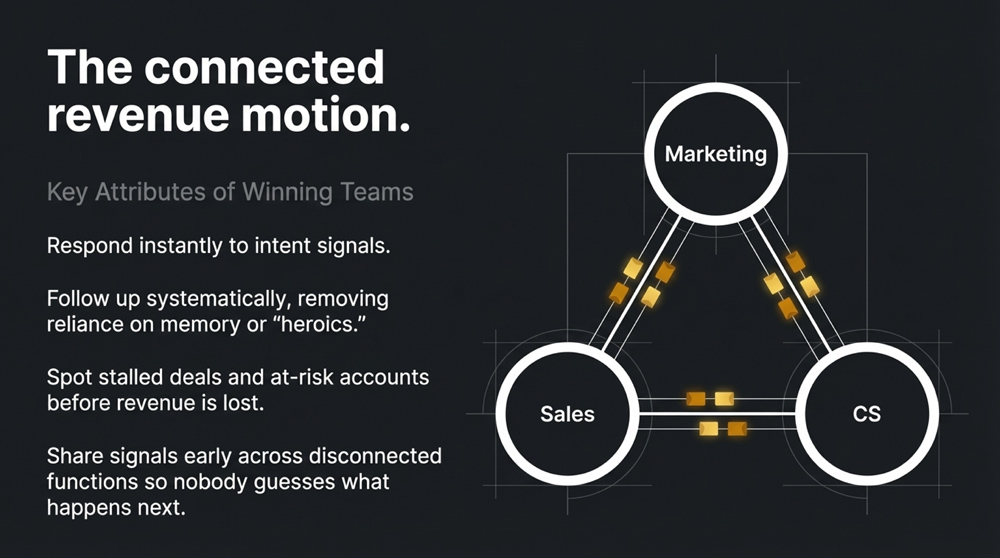
They will respond faster when a lead shows intent.
They will follow up with more consistency instead of relying on memory or good intentions.
They will spot stalled deals and at-risk accounts earlier, before the problem turns into lost revenue.
They will make the next step clearer at every stage so prospects and customers are not left sitting in confusion or silence.
And just as importantly, they will stop treating marketing, sales, and customer success like disconnected functions. Winning teams will use AI to support a connected revenue motion, where handoffs are cleaner, signals are shared earlier, and nobody is guessing about what is supposed to happen next.
That is a big difference.
Because weaker teams will still approach AI like an add-on. More tools. More prompts. More automation layered on top of the same unclear ownership, inconsistent follow-up, and broken workflows they already had. So even if they look busier or more advanced on the surface, the underlying execution still stays messy.
Winning teams will be different.
They will use AI inside a defined operating rhythm. They will know who owns the next move. They will know what signals matter. They will know what must happen after a lead comes in, after a call ends, after a proposal goes out, and after a customer starts to drift.
In short, they will not just automate tasks. They will strengthen execution.
And that leads to the deeper point underneath all of this: AI only becomes real leverage when there is an actual system underneath it.
Why a system matters more than tools
That is the deeper issue that many businesses miss.
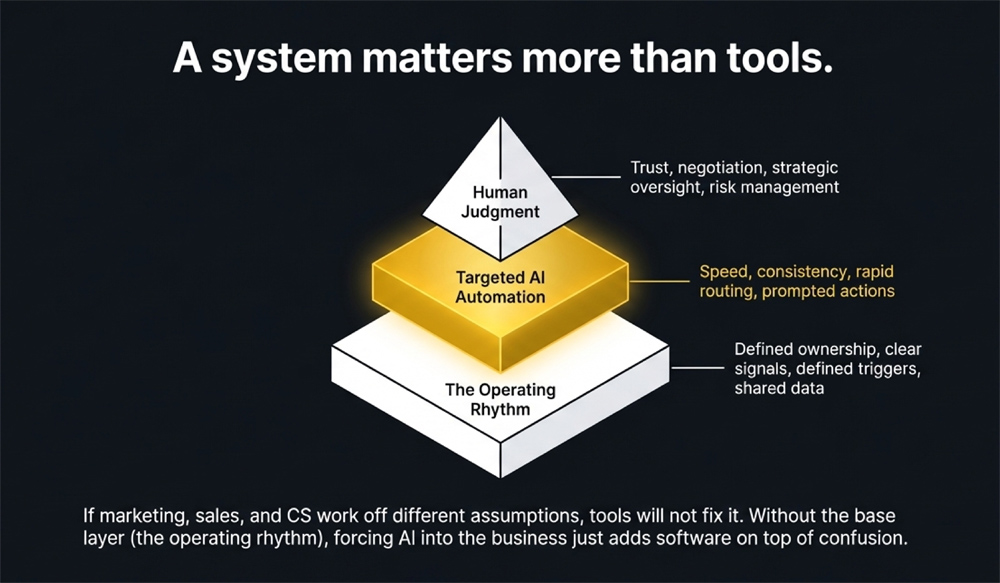
Tools can help. AI can help. Automation can help. But none of them can carry a revenue engine that has no real structure underneath it.
If the follow-up process is unclear, the tool will not fix that.
If ownership is fuzzy, the tool will not fix that.
If marketing, sales, and customer success are working off different assumptions, different data, and different definitions of progress, the tool will not fix that either.
At that point, all the business has done is add more software on top of confusion.
That is why a system matters more than tools.
A real system defines what happens, when it happens, who owns it, what signals matter, and what the next step should be when something stalls, goes quiet, or starts to slip. It creates consistency across the parts of the revenue process that usually break down under pressure. It gives AI something useful to support instead of forcing it to operate inside chaos.
Without that kind of structure, AI just speeds up broken workflows.
With it, AI becomes leverage.
It can help teams respond faster, follow up better, route work more cleanly, surface risk earlier, and maintain momentum without relying so heavily on memory, heroics, or constant founder involvement.
So the real advantage is not having more tools than everyone else.
It is having a stronger operating system for revenue, then using AI to make that system sharper, faster, and more consistent.
And that brings us to the bottom line: the teams that benefit most from AI will not be the ones chasing the newest features. They will be the ones using AI to strengthen how revenue actually gets executed.
Final thoughts
AI is not replacing sales teams. It is not replacing customer success teams either.
What it is replacing is slow follow-up, repetitive admin, weak execution, and all the low-value work too many businesses allowed to sit at the center of revenue generation for too long.
That is the real shift.
The value of the human role is moving higher. Toward judgment. Toward trust. Toward clearer thinking. Toward seeing problems early, guiding better decisions, and helping revenue move forward with more precision.
At the same time, AI is raising the standard. It is making inconsistency easier to spot. It is exposing weak handoffs, unclear ownership, and the gap between activity and actual progress.
So the question is not whether a business is using AI.
The real question is whether AI is being used to fix the places where revenue leaks, execution breaks down, and customers drift, or whether it is just helping the team move low-value work around faster.
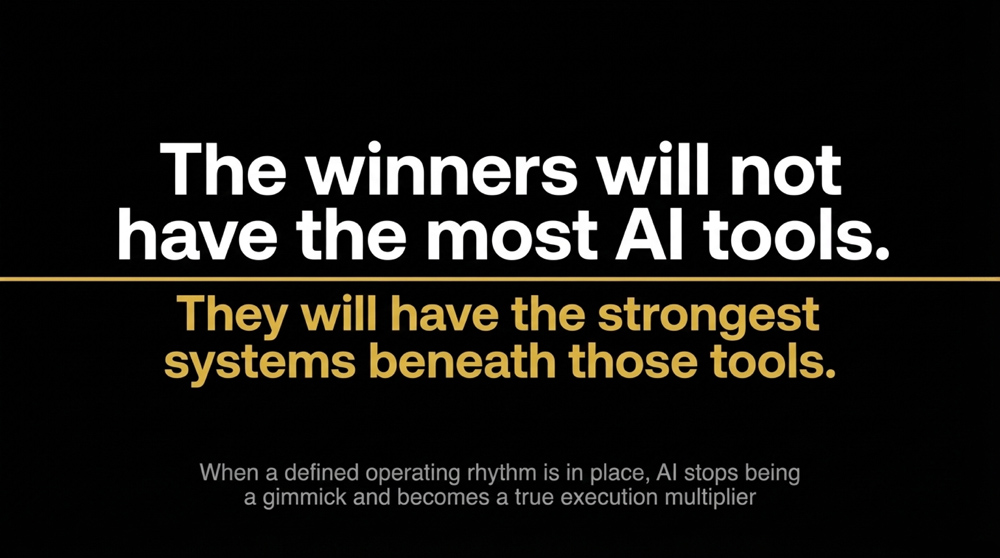
Because the teams that win will not be the ones with the most tools.
They will be the ones with the strongest system underneath the tools.
And when that system is in place, AI stops being a gimmick and starts becoming what it should have been all along: a real advantage in how revenue gets executed.